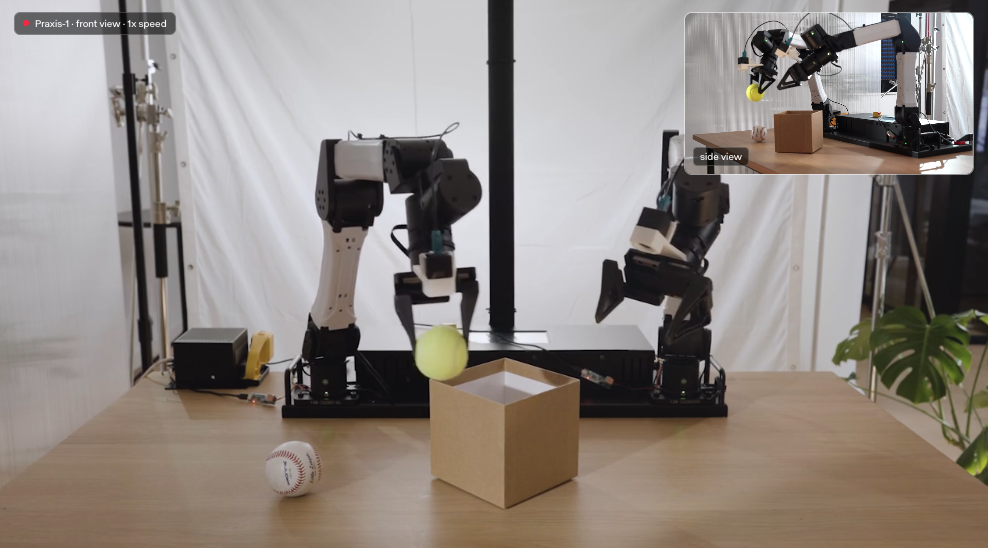
Runway announced Praxis-1, its first "world action model" for robotics, built on the same video pretraining infrastructure that powers its generative video products. The model will be released with open weights in the coming months, allowing robotics developers to download, run, and adapt it locally rather than accessing it through Runway's API.
The core technical argument is that robots don't need to learn primarily from robot-generated data. Collecting teleoperated robot footage is expensive and time-consuming. Runway instead trains Praxis-1 on massive quantities of ordinary web video — teaching it object behavior, physics, and how humans perform tasks — then fine-tunes it for specific robot hardware. In one experiment, a policy pretrained on web video achieved a 16.1 cm placement error versus 16.0 cm for a policy pretrained on teleoperated robot footage. The difference is statistically insignificant.
Runway is testing Praxis-1 with three early partners: Noble Machines (bimanual manipulation), Standard Bots (RO1 arm), and Ultra Robotics (mobile platform). The company reports that simulating robot policies inside its world model produces results with a 0.95 correlation to real-world performance. Testing includes cluttered environments, transparent objects, deformable materials, and deployment across both studio and domestic kitchen settings without retraining.
The approach mirrors how large language models acquire broad language understanding from text before task-specific fine-tuning. If it scales, Praxis-1 reduces robotics' persistent data bottleneck: the lack of diverse real-world training data needed to operate reliably outside controlled environments. Runway's move into Physical AI also positions it as a direct competitor to robotics foundation model efforts from Google DeepMind, Physical Intelligence, and others.
The open-weight release is strategic. Runway argues that interoperability between AI models and robot hardware will be critical as Physical AI matures, and open access gives hardware developers flexibility they currently lack. Applications for early access are open now.