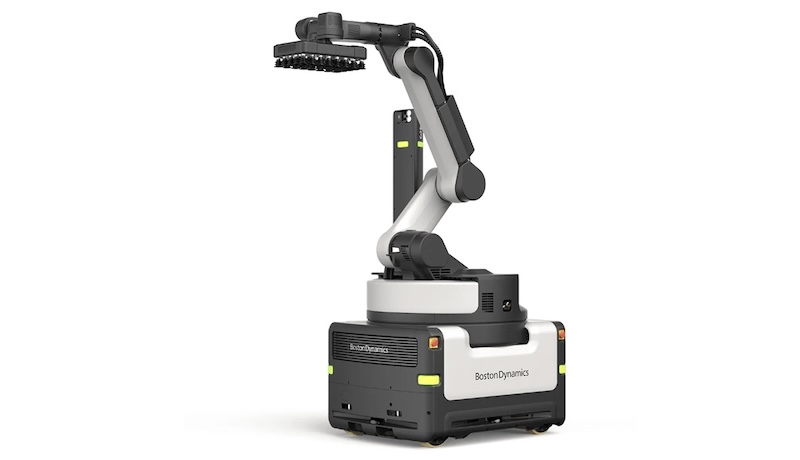
Boston Dynamics released Stretch Gen 2, the second generation of its mobile warehouse unloading robot, with hardware upgrades engineered to reduce unplanned downtime in high-volume logistics operations. The company analyzed data from over 100,000 operating hours across its deployed fleet to identify the failure modes that most often took robots offline.
The Gen 2 design removes 81% of internal cabling — roughly half a mile of wiring — eliminating the leading cause of intermittent electrical faults. Continuous rotation joints replace hard-stop designs that previously caused mechanical stress. Swerve drive modules now swap in one hour instead of a full day. Automotive-grade connectors, recessed emergency stops, and reinforced exterior panels reduce nuisance shutdowns from falling boxes and dock floor vibration.
Stretch holds the largest deployment footprint in robotic trailer unloading, a category it pioneered. The reliability improvements directly address operational constraints in 24/7 distribution centers where downtime compounds quickly. The robot unloads up to 1,000 cases per hour depending on load density and case weight, with a two-shift battery and 75-minute fast charge.
The Gen 2 platform runs on a redesigned compute stack with over-the-air updates for perception, motion planning, and multipick strategies. Boston Dynamics is positioning software-defined capability as a hedge against hardware commoditization, but the durability-first messaging signals that uptime and service cost remain the primary buying criteria for logistics operators evaluating robotic alternatives to human unloaders.