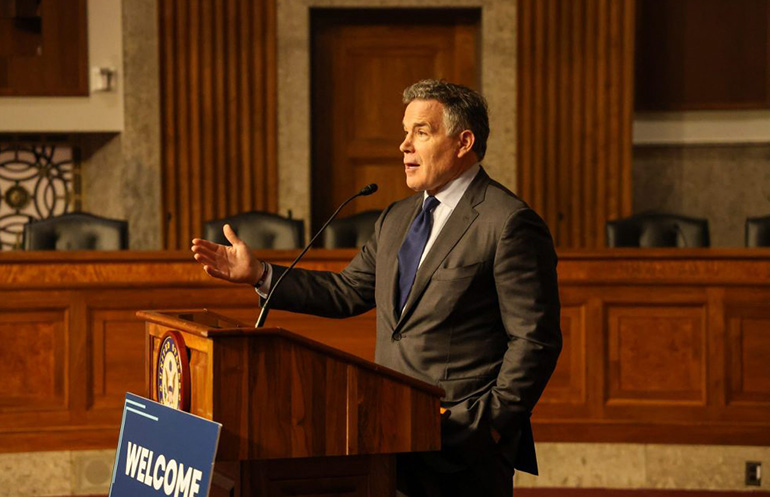
Senators Dave McCormick (R-Pa.), John Hickenlooper (D-Colo.), Todd Young (R-Ind.), and Martin Heinrich (D-N.M.) introduced legislation last week to create a National Commission on Robotics. The commission would assess U.S. competitiveness, supply chain vulnerabilities, workforce gaps, and foreign policy moves — particularly China's rapid robot deployment.
A companion bill already exists in the House (H.R. 7334), introduced in February by members of the Congressional Robotics Caucus. The Senate version signals broader political momentum for federal coordination on robotics, which industry leaders say has been fragmented across agencies with no unified strategy.
China has deployed more industrial robots than the rest of the world combined, according to IFR data. U.S. robot density has risen since 2024, but competitive pressure continues to grow. Industry figures argue that without policy alignment on workforce training, domestic manufacturing incentives, and standards development, reshoring efforts will depend on foreign automation technology.
The proposal follows related efforts including the SCSP's National Security Commission on Robotics for Advanced Manufacturing and the formation of Robots for America — an industry coalition pushing for robotics as a recognized pillar of U.S. industrial policy. Multiple tariff investigations and export controls on humanoid systems from adversary nations are also in motion, but none constitute a comprehensive national strategy.
Jeff Burnstein, president of A3, called the commission "the first major step on the road to a U.S. National Robotics Strategy" and noted that delays risk falling further behind in both robotics and physical AI development.