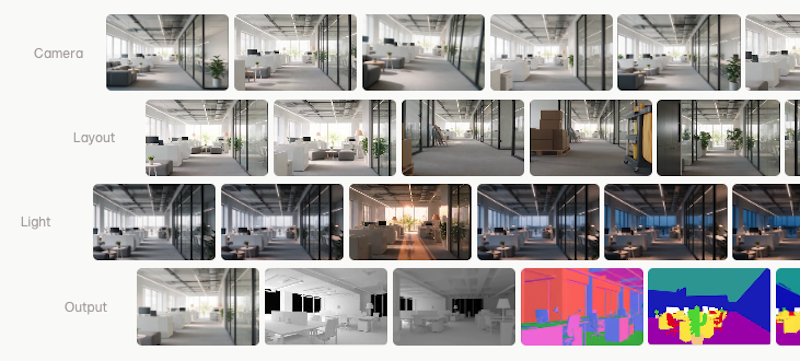
Genesis AI closed a $105M seed round co-led by Eclipse and Khosla Ventures to build a general-purpose foundation model for robotics. Founded by Zhou Xian (Carnegie Mellon PhD in robotics) and Théophile Gervet (ex-Mistral AI research scientist), the startup is developing a model trained entirely on synthetic data generated by a proprietary physics simulation engine.
The physics engine originated from an academic project led by Xian across 18 universities. Genesis claims the engine can accurately model physical world dynamics, enabling faster iteration than competitors reliant on Nvidia's simulation software. Several academic collaborators from the original project now form Genesis' 20+ person research team.
The robotics foundation model market is heating up. Physical Intelligence raised $400M in 2024, and Skild AI reached a $4B valuation earlier this year. Both rely on combinations of real-world and simulated data. Genesis' bet is that fully synthetic training data — if physically accurate — removes a major scaling constraint.
Real-world robotics data is expensive and slow to collect. If Genesis' simulation engine can generate training data that transfers reliably to physical systems, it could compress development timelines and reduce dependence on costly hardware fleets for data collection. The risk is simulation-to-reality gap — a long-standing challenge in robotics AI.
Genesis operates out of Silicon Valley and Paris. The company plans to release its model publicly by end of 2025, which will serve as the first real test of whether synthetic-only training can match or exceed real-world data approaches.