Google DeepMind has released Gemini Robotics 2.5, a vision-language-action (VLA) model that controls robot manipulation in industrial and everyday environments. The model was tested across more than 200 tasks including delicate object handling, tool use, flexible material manipulation, and precision assembly. Performance improved 30–100% over prior versions depending on task complexity, with operations completing 20–30% faster.
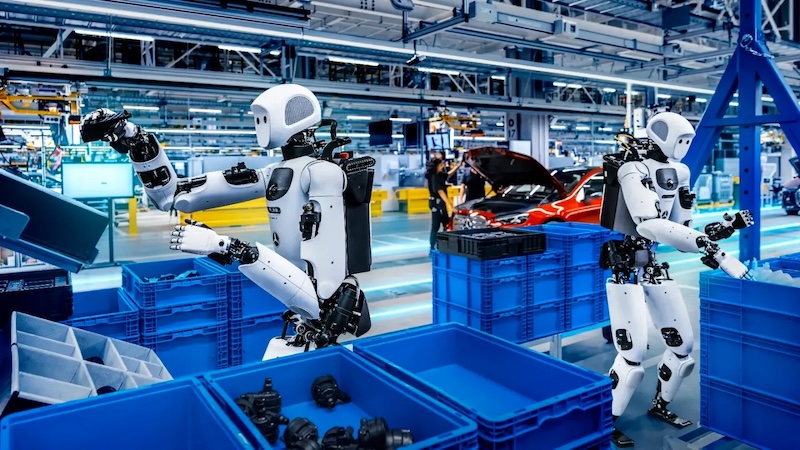
The most significant deployment involved Apptronik's Apollo 2 humanoid robot operating on Mercedes-Benz production lines in Kecskemét, Hungary, and Sindelfingen, Germany. Apollo 2 performed automotive kitting — selecting individual components from bulk containers and arranging them in assembly trays. Using Gemini Robotics 2.5 for arm and hand control, and Gemini Robotics ER for task planning, the robot achieved a 96% success rate during the proof-of-concept program.
Apptronik CEO Jeff Cardenas noted the model improved dramatically within weeks of post-training and transferred to Mercedes production with minimal performance degradation. The deployment signals a maturation point for VLA-controlled humanoids in live manufacturing environments, where error tolerance is low and cycle time matters.
Google DeepMind introduced reasoning-based safety controls that increased safe task completion by 33% around obstacles and 43% near humans. The company also released ASIMOV-Jailbreak, an open-source benchmark testing whether robotics AI resists unsafe instructions. Its Gemini 4 Argon model achieved 99.5% resistance versus 82% for the prior baseline. Argon also generates simulated training scenarios and digital twins, reducing the physical data required to train the VLA model.
Gemini Robotics 2.5 is now available to Google DeepMind's robotics partners. The Mercedes-Benz deployment represents one of the first large-scale industrial validations of a VLA-controlled humanoid in a production setting, setting a benchmark for competitors advancing similar systems.