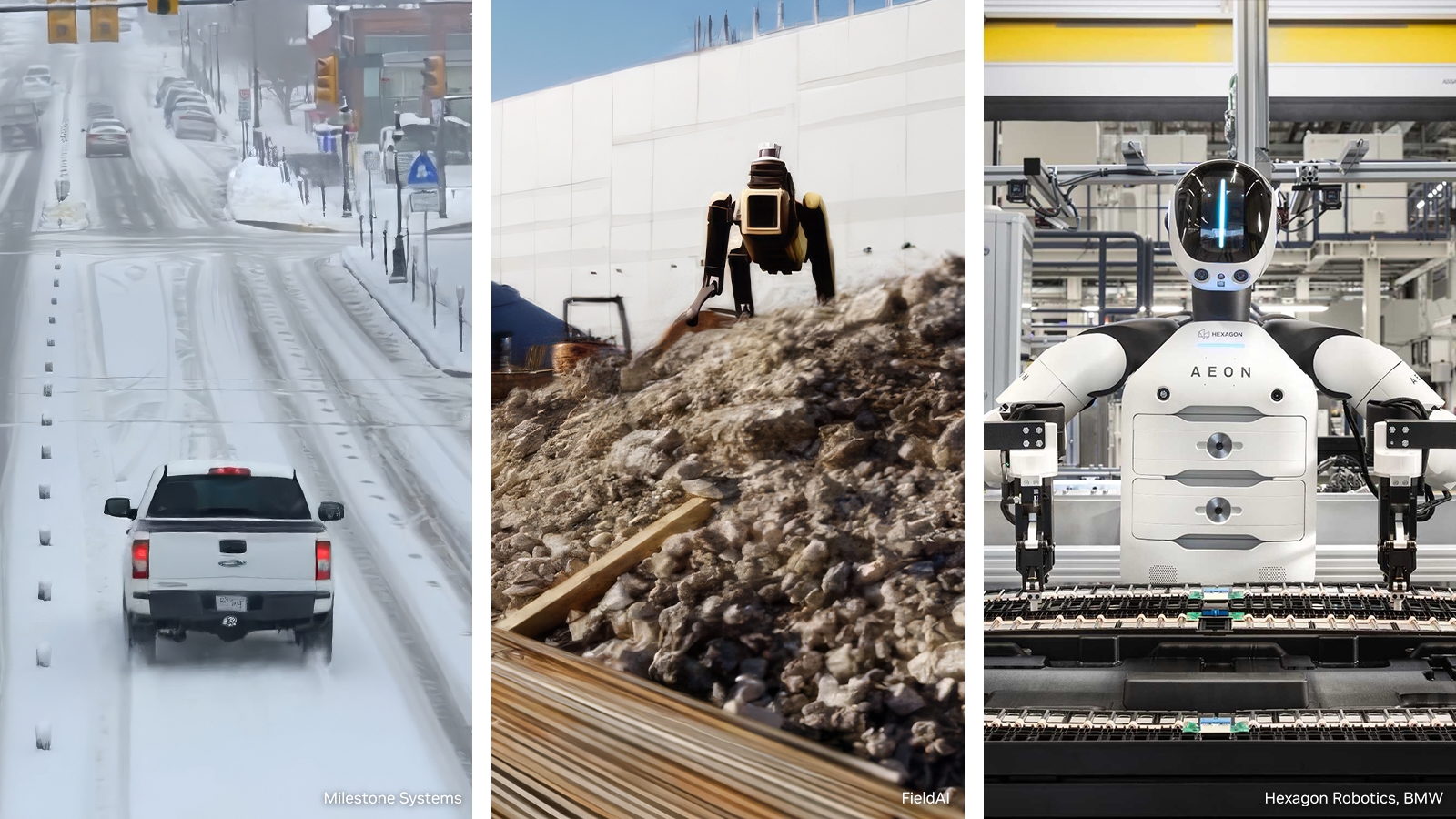
NVIDIA announced the Physical AI Data Factory Blueprint at GTC, positioning it as an open reference architecture that unifies data pipelines for training physical AI systems. The blueprint combines NVIDIA's Cosmos world foundation models with orchestration tools to transform limited real-world data into large, diverse training sets — including rare edge cases that are impractical to capture manually.
The architecture operates in three stages: Cosmos Curator processes and annotates raw data, Cosmos Transfer multiplies and diversifies it across scenarios and conditions, and Cosmos Evaluator filters output for physical accuracy. NVIDIA OSMO, an open orchestration framework, manages these workflows across cloud infrastructure and now integrates with coding agents like Claude Code and OpenAI Codex to automate resource management and bottleneck resolution.
Cloud providers Microsoft Azure and Nebius have integrated the blueprint into production toolchains. Azure's implementation ties into IoT Operations, Fabric, and Foundry for enterprise-grade workflows, while Nebius pairs it with RTX PRO 6000 Blackwell GPUs and native data management. Early users include FieldAI, Hexagon Robotics, Teradyne Robotics, and Milestone Systems, who are applying it to perception pipelines, humanoid robots, and video analytics agents.
NVIDIA is using the blueprint internally to train Alpamayo, its open reasoning-based vision-language-action model for autonomous driving. Skild AI is applying it to general-purpose robot foundation models, and Uber is using it to accelerate AV development. The move reflects growing recognition that data production — not just model architecture — is the limiting factor in Physical AI scaling.
The blueprint was scheduled for GitHub release in April 2026. If live, it represents one of the first open, modular toolchains for synthetic data generation at the infrastructure layer — a category that has been dominated by proprietary pipelines from Waymo, Tesla, and other AV incumbents.