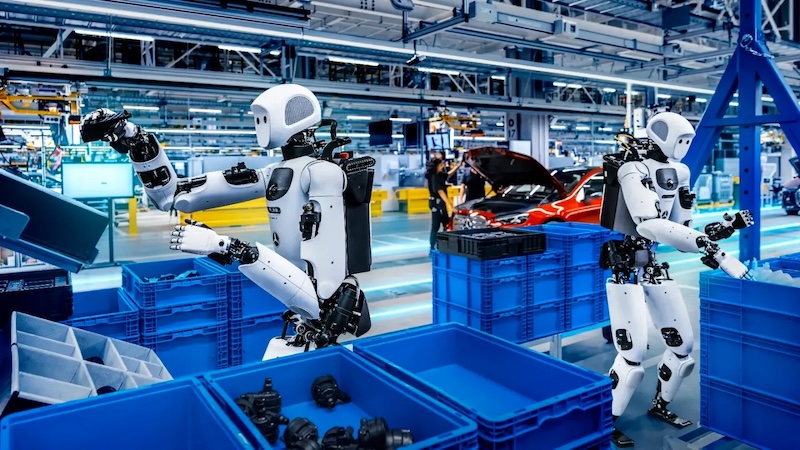
The open-source movement that transformed software AI is now being applied to robotics. Companies including Hugging Face, Nvidia, and Alibaba have released tools and pre-trained models aimed at the higher-level work of getting robots to reason, decide, and act. The shift represents a fundamental change in who can build capable robots.
Hugging Face launched LeRobot in May 2024 as a community platform for robotics AI. Since then, robotics datasets on the platform grew from 1,145 to over 58,000 — making it the single largest dataset category on Hugging Face. Contributors range from industry giants to academic labs and hobbyists. The company acquired robotics firm Pollen Robotics to complement its software platform, recognizing that open-source hardware is necessary to fully democratize access.
Nvidia's open-source robotics stack covers the full pipeline. Its Cosmos world models generate synthetic training data, GR00T models handle reasoning and task execution, and Isaac frameworks orchestrate training, simulation, and deployment. Spencer Huang, Nvidia's director of product for robotics, notes that computer vision tasks that once required significant expertise can now be done in a few lines of code. Alibaba released RynnBrain in early 2025, an open-source foundation model for physical AI that the company claims outperforms comparable offerings from Google and Nvidia on benchmarks.
The lowered barrier has drawbacks. Bill Smart, a professor at Oregon State who was part of the early open-source robotics community, notes that newcomers from AI backgrounds sometimes reinvent solutions the robotics field solved decades ago. A researcher might spend a week training a neural network for basic motion control that can be accomplished with a few lines of classical code. The commercial incentives behind today's open-source releases also differ from the academic pooling that produced ROS — the Robot Operating System that became the de facto standard after its 2007 debut.
The impact is real regardless of motive. "Anyone can make a robot move now," says Smart. "As an old tech guy, that makes me happy and sad, because I'm no longer special." Clement Delangue, Hugging Face's CEO, argues the stakes go beyond convenience — a world where only proprietary systems control home robots is concerning. Open source provides an alternative path to distributed control and transparency.