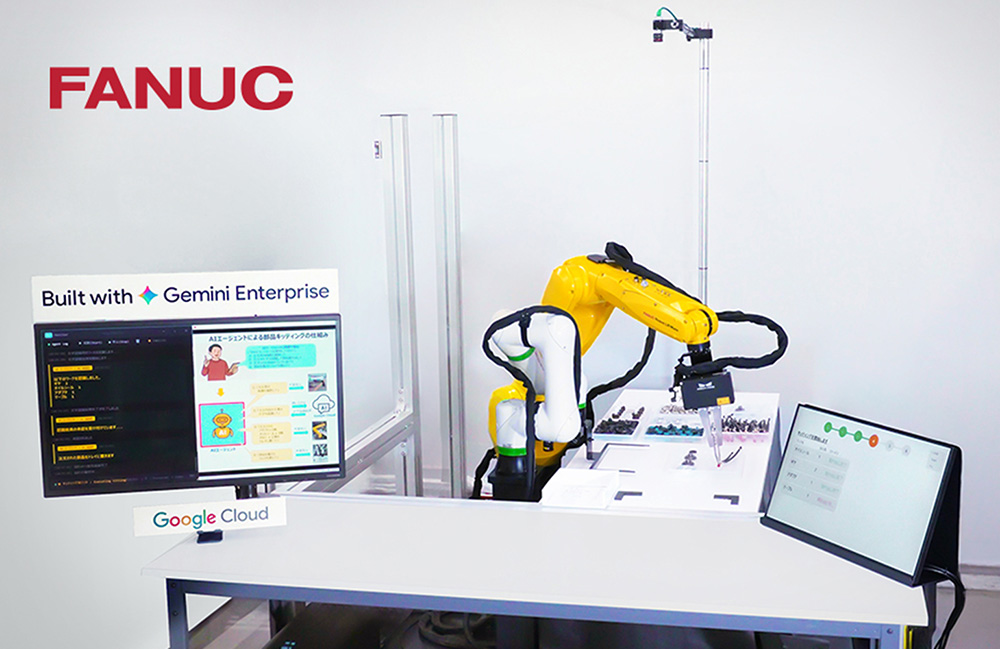
FANUC is partnering with Google to deploy physical AI across its industrial robot lineup, from small 3kg payload units to 2.3-ton heavy industrial arms. The integration leverages Google's AI technologies, including capabilities from its Intrinsic robotics unit, which maintains the Robot Operating System (ROS) that FANUC's robots support natively.
The technical foundation centers on FANUC's open platform approach: ROS drivers, Python support for AI development, high-speed external control interfaces, and PLC integration. This architecture allows manufacturers to deploy perception, autonomous decision-making, and adaptive task execution without replacing existing automation infrastructure.
Customer adoption is accelerating. FANUC reports shipping over 1,000 physical AI-enabled robots since the December 2024 IREX Tokyo launch — a faster ramp than typical industrial robot deployments. The partnership targets variable production environments where traditional fixed automation struggles, positioning FANUC to compete with emerging flexible automation vendors.
The Google collaboration also tightens FANUC's integration with NVIDIA Isaac Sim, creating a unified simulation-to-deployment pipeline for AI-driven factory automation. As manufacturers shift from "whether to use AI" to "how to deploy it," FANUC is betting that open standards plus hyperscaler AI partnerships will capture the market ahead of closed-ecosystem competitors.