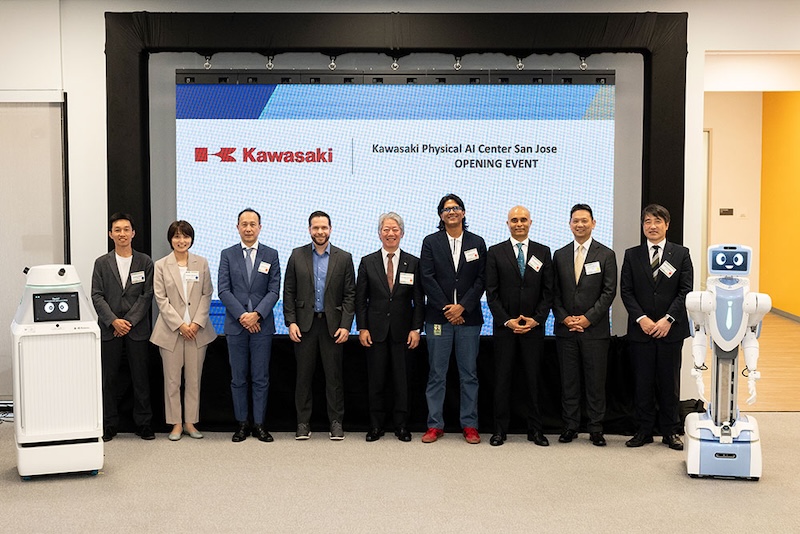
Kawasaki Heavy Industries opened the Kawasaki Physical AI Center San Jose on May 21, establishing a West Coast hub for developing real-world AI-driven robotics. The facility will serve as the anchor for partnerships with Nvidia (AI/robotics integration), Analog Devices (sensing and voice recognition), Microsoft (cloud infrastructure), and Fujitsu (healthcare system integration).
The center's first application is a comprehensive hospital automation platform combining AI with Kawasaki's hinotori surgical robot, Nyokkey service robot, and Forro delivery robot. CEO Yasuhiko Hashimoto framed the vision as "Physical AI that supports human judgment and action" rather than full human replacement — a positioning likely aimed at healthcare worker concerns over displacement.
Kawasaki's "Physical AI" definition emphasizes autonomous perception, reasoning, and action in real environments using operational data from industrial deployments. This positions the company to leverage decades of industrial robotics data as training material for healthcare-focused models — a potential advantage over pure software AI firms entering the space.
The move reflects broader consolidation in the Physical AI stack. Major industrial robotics players are racing to integrate frontier AI capabilities before software-first companies (OpenAI, Anthropic) or cloud platforms (AWS, Google Cloud) commoditize the robotics layer. Kawasaki's bet is that domain expertise in mechanical systems and regulatory-cleared medical devices creates defensible moats.
Healthcare automation is a high-stakes testbed. Japan and the US face severe elder care labor shortages, but medical robotics must clear safety, liability, and reimbursement hurdles that hobble many AI deployments. Success in this vertical would validate Physical AI business models across logistics, manufacturing, and defense.