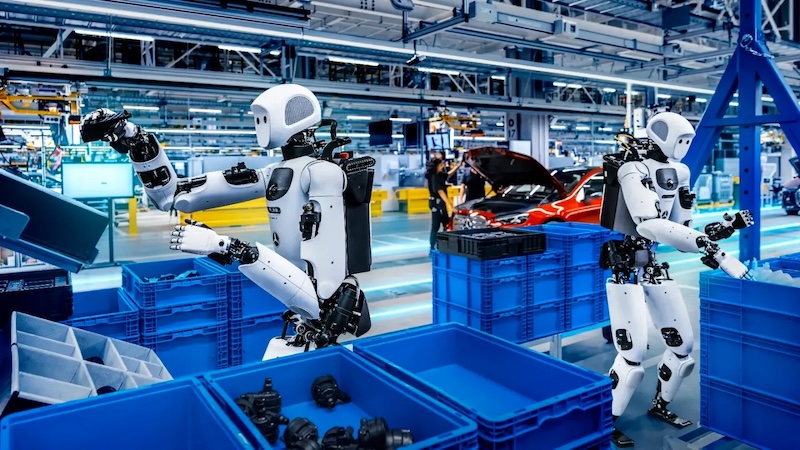
The National and Local Co-Built Humanoid Robotics Innovation Center will open its doors in July with a diverse class of humanoid robots training across a 5,000-square-meter facility. The inaugural cohort includes models from more than a dozen companies, each with varying form factors and capabilities. The goal is dual-purpose: prepare these robots for deployment in domestic, industrial, medical, and agricultural settings while generating a massive training dataset for the entire industry.
Robots will master 45 "atomic skills" — grasping, picking, placing, transporting — through supervised repetition. A single core movement may be performed 600 times per day under researcher observation. The curriculum focuses on 10 key task categories including folding clothes, shelf organization, and equipment cleaning. These remain difficult challenges for current-generation humanoids despite rapid progress in locomotion and dexterity.
The facility reflects China's collaborative robotics ecosystem, where manufacturers share infrastructure, components, and now training data. General manager Xu Bin emphasized the center's role in enabling "large-scale data sharing and utilization, empowering the entire industry." The accumulated 10 million annual data points will feed a generalized "super brain" model that allows robots from different vendors to benefit from collective learning.
Director Yang Zhengye noted that the data exchange model will let companies focus on vertical specialization — healthcare, hospitality, manufacturing — while the shared foundation handles core motor skills. This approach mirrors China's broader strategy of accelerating robotics development through coordinated industrial clusters rather than isolated vendor R&D.