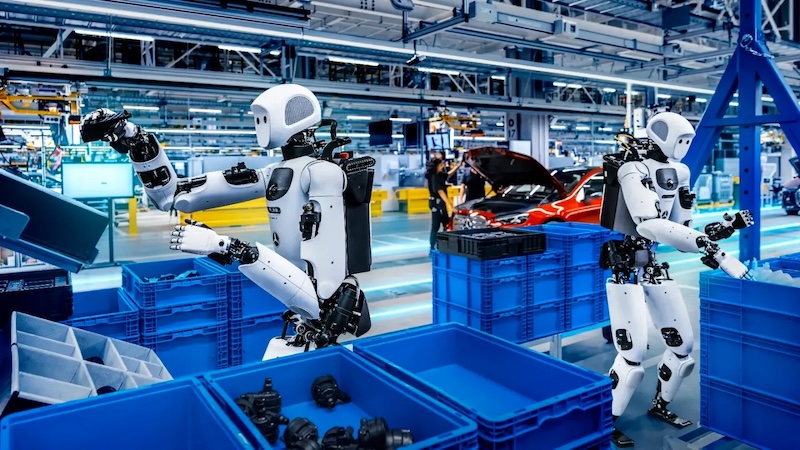
Nvidia unveiled a reference design humanoid at GTC Taipei, combining a Unitree body, five-fingered hands, Nvidia onboard computing, and software tools. The blueprint aims to reduce fragmentation in humanoid research by providing a turnkey platform, with availability expected in late 2026. OpenAI simultaneously announced robotics as a strategic priority, posting openings for ML engineers and 3D printing technicians to support its household task research program.
The competitive landscape is fragmenting between research-focused platforms and commercial deployments. Figure AI, valued at $39B, signed a deal with Catalyst Brands to deploy humanoids in JCPenney and Brooks Brothers distribution centers. Agility Robotics has active deployments with Amazon and GXO. Boston Dynamics plans to field tens of thousands of Atlas units in Hyundai factories by 2028.
Venture funding reflects the urgency: global robotics and Physical AI investment grew from $4B in 2019 to $26B in 2025, with $23B raised in the first half of 2026 alone. The capital is flowing toward hardware integration, manipulation software, and real-world training datasets — the infrastructure needed to move humanoids from demos to production environments.
Tesla remains the wildcard. Elon Musk claims Optimus is performing simple factory tasks and projects consumer availability by end of 2027, but the company has disclosed minimal technical detail or deployment data. If Tesla delivers at scale, it collapses the timeline for commodity humanoid hardware. If not, the field remains open for specialists like Figure and Agility to define the industrial standard.