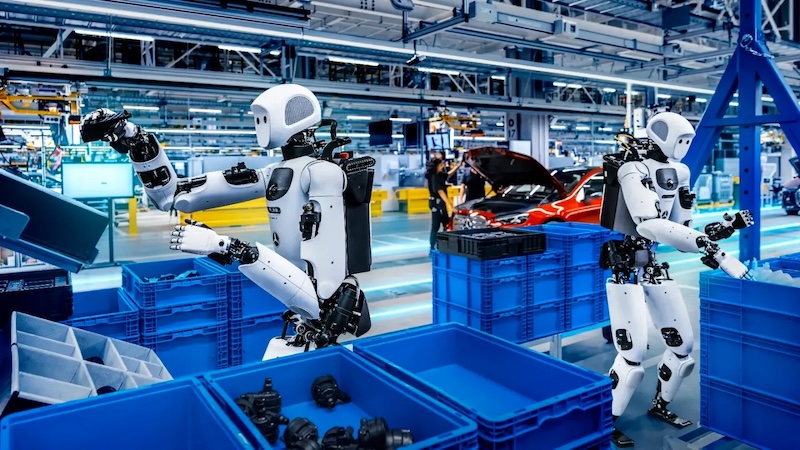
At Tokyo's Humanoids Summit, Chinese robots dominated the floor while Japan's humanoid pioneers largely showed retrofitted foreign hardware. Chinese systems from Unitree, Booster Robotics, and High Torque Technology performed demos, while Japanese companies GMO AI & Robotics and Omakase exhibited modified Unitree G1 units for airport cargo handling and R&D. Geminoid HI-6 — a 20-year-old android replica of researcher Hiroshi Ishiguro — was one of the few Japanese humanoids present.
Japan's early lead evaporated through a combination of bad timing and commercialization failure. Honda's Asimo was retired in 2022, the year ChatGPT launched. Two years later, Unitree released the G1 for $16,000. Japan also lost ground in industrial automation: it held the top spot in manufacturing robot density from 1994 to 2009, but has since dropped to fifth place. China now operates 2 million industrial robots — 4.5 times Japan's total — and accounts for 54% of global annual installations.
McKinsey estimates Japan has a $100 billion opportunity in general-purpose robotics, but must shift focus from hardware excellence to AI, software, and data platforms. Tetsuya Ogata of Waseda University's AI Robot Association is building shared datasets — including 80,000 hours of mobile manipulator teleoperation data — to create foundation models for the industry. The goal is an open "data ecosystem" that allows Japanese firms to compete on applications rather than reinventing infrastructure.
Japan's challenge mirrors its smartphone experience: it pioneered mobile internet in 1999 but failed to capture the smartphone era, becoming a parts supplier instead. Robotics experts warn that without deregulation, open collaboration, and faster commercialization, Japan risks repeating that outcome in humanoids — losing influence over an industry it invented.