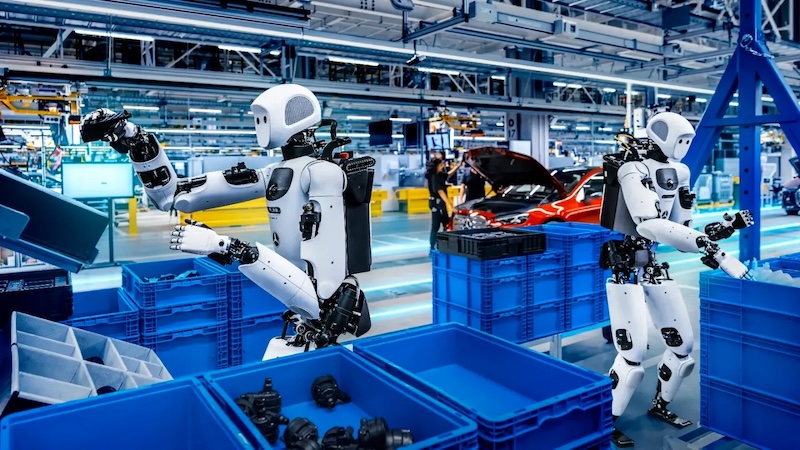
Boston Dynamics announced a complete redesign of Atlas' hand, moving from three fingers and 7 degrees of freedom to four fingers and 13 DoF. The new design eliminates the pinky but adds finger splay and trigger-grip capability for tools like drills and welding torches. According to Alberto Rodriguez, Director of Robot Behavior, the team deliberately avoided the human-mimetic designs favored by competitors, which he describes as "giving up on reliability and manufacturability."
The hand uses direct-drive actuators embedded in each joint, with no tendons or cables across joints to fail. Each actuator pack is a modular unit designed for field replacement. Boston Dynamics is already optimizing the design for 100,000-unit annual production, a scale that forces different engineering tradeoffs than research prototypes.
The superhuman finger splay enables grips beyond human capability. Rodriguez notes that reinforcement learning can discover and exploit these extra motions. The design reflects a fundamental tension in humanoid robotics: anthropomorphic hands look impressive in demos but struggle with the "ruthless design tradeoffs" required for commercial deployment.
This positions Boston Dynamics against competitors like Figure, Agility Robotics, and Tesla, many of which use five-finger hands that mimic human form more closely. Whether those designs can achieve similar manufacturability at scale remains an open question. The Atlas hand bet is that superhuman capability matters more than human appearance when the goal is deployment, not demos.