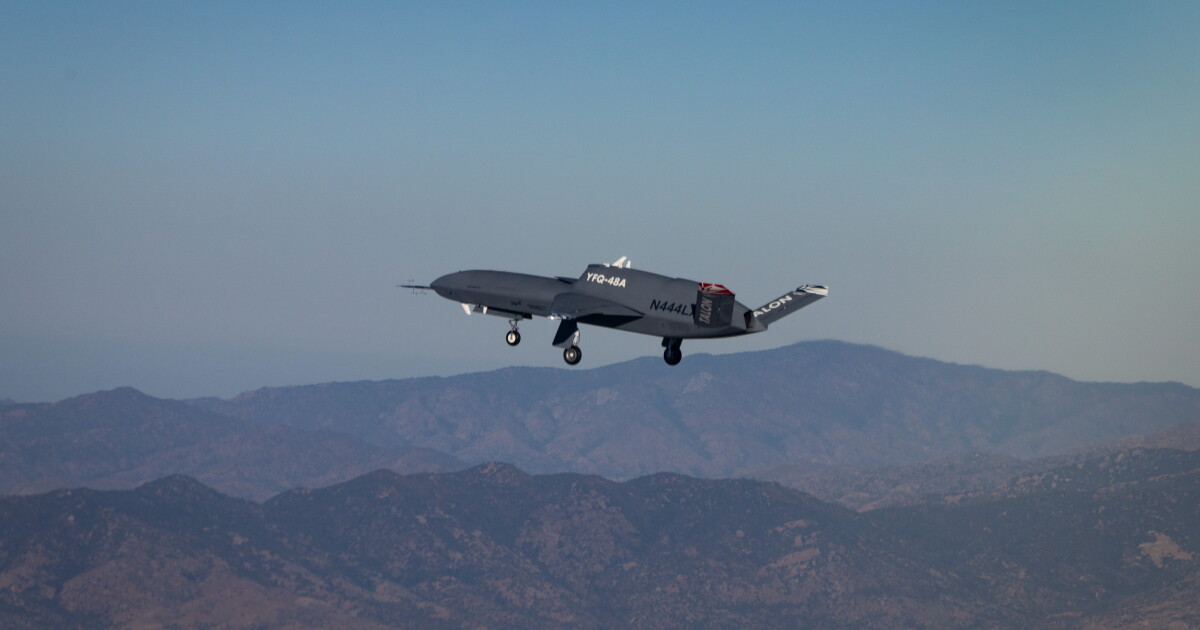
Northrop Grumman's YFQ-48A Blue Talon autonomous fighter completed its maiden flight at Mojave, California, controlling all phases from engine start to landing without pilot input. The company-funded platform is designed to operate alongside F-35 and F-22 aircraft in contested airspace, performing high-risk missions including forward missile deployment, electronic warfare, reconnaissance, and target designation.
Blue Talon integrates stealth features typically reserved for heavier, more expensive platforms. The design includes a fuselage chine for radar deflection, a dorsal air intake to shield against ground radar, and internal weapons bays. The modular configuration reduces component count, cuts weight by 50%, and shortens manufacturing time by 30% compared to conventional autonomous fighter designs.
The platform uses Integrated Dual-Track Autonomy Maturation, developing software independently of the airframe. This approach decouples AI validation from physical flight testing, compressing development cycles from years to months — a response to current geopolitical pressures demanding faster fielding timelines.
The shift toward mass-producible autonomous fighters reflects a strategic gap in Western defense: the need for attritable platforms that can absorb losses in contested environments while preserving manned aircraft. Blue Talon's economics are designed to enable production at scale, where cost per unit becomes the enabler for numerical overmatch rather than a barrier.