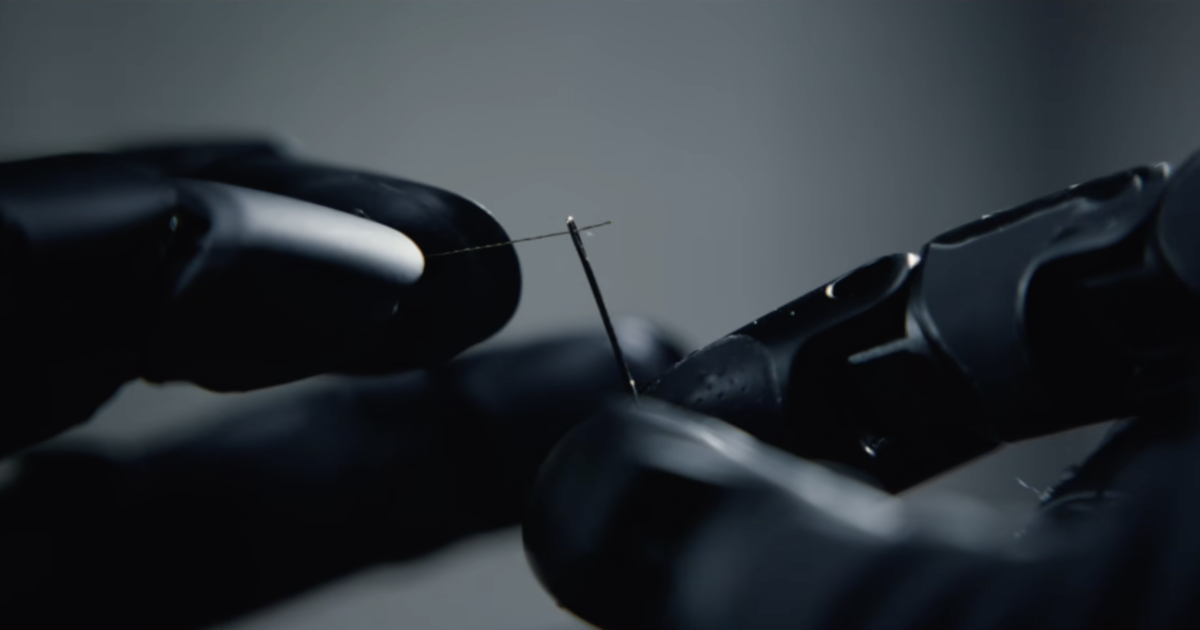
Agilink, a spin-off of Chinese robotics firm AgiBot, demonstrated its OmniHand 3 Ultra performing traditional Suzhou embroidery — a craft requiring the hand to split silk threads into 16 individual strands, thread needles, and maintain precise tension while stitching. The task demands coordinated finger positioning, force modulation, and tactile feedback at scales where errors of 0.2 mm matter.
The OmniHand 3 Ultra-M uses direct-drive motors with no tendons or transmissions between actuator and joint. It weighs 630 g, repeats positions to within 0.2 mm, and detects fingertip deformations of 0.08 mm via vision-based sensors embedded in each digit. The palm adds a 300-point contact sensor array. The hand can hold 3 kg stably and lift up to 8 kg.
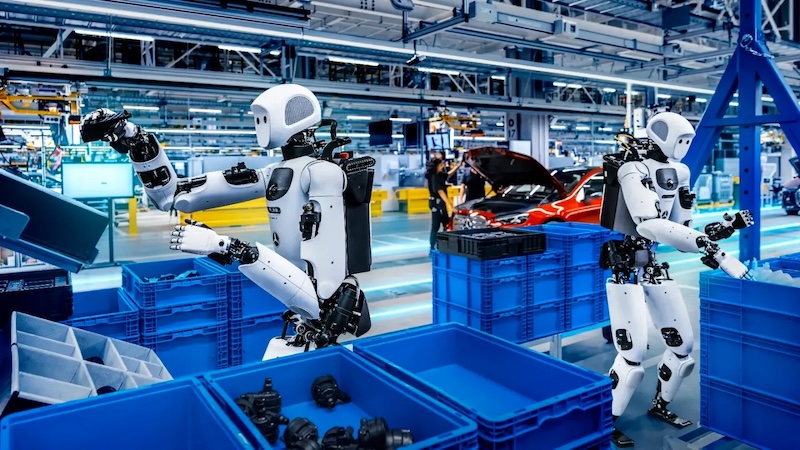
Fine-force manipulation remains the critical gap between industrial arm replacement and general-purpose humanoids. Boston Dynamics' new Atlas hand uses only four fingers, arguing that reliability and tool compatibility matter more than anatomical fidelity for factory work. LinkerBot's tendon-driven Linker Hand L30 Pro mimics human anatomy but trades fingertip force for speed and repeatability.
Agilink's silk demonstration is a proof-of-capability exercise, not a commercial deployment. The real test is whether this level of dexterity can scale into eldercare, domestic assistance, or medical tasks — contexts where breaking a porcelain cup or applying too much pressure to skin is unacceptable. The embroidery stunt shows the hardware exists. Integration with robust tactile feedback loops and real-time control is the next engineering frontier.