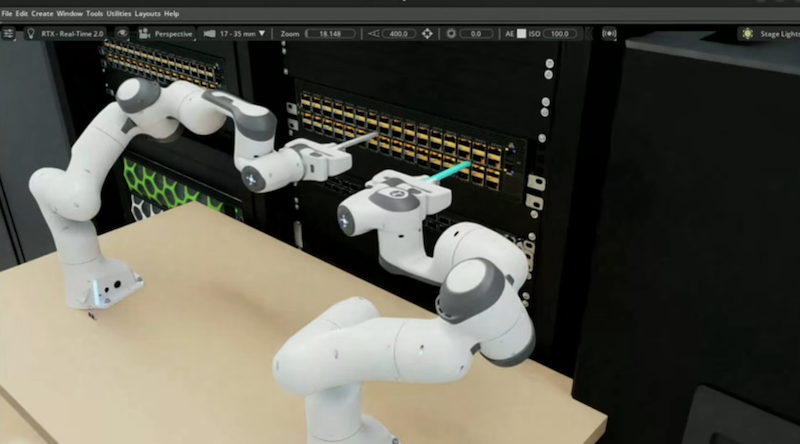
DataraAI announced a robotic automation platform designed to handle cable routing, connector seating, and wiring harness manipulation in AI server and rack production. The California-based startup says cabling remains a manual bottleneck even in otherwise automated assembly lines, where thousands of connections must be routed and terminated by hand.
The system combines RGB-D vision, force and torque sensing, and tactile feedback to enable industrial robot arms to manipulate deformable cables and verify correct connector seating. Unlike standard sim-to-real approaches that train in simulation first, DataraAI captures data from real manufacturing operations to calibrate its simulations, then uses those simulations to scale learning.
The company has joined Arm Total Design for Physical AI and is participating in Arm's Robotics Capability Framework, an effort to standardize capability descriptions across robotic systems. DataraAI is positioning the platform as a pre-calibrated solution that manufacturers can validate on their own hardware before committing capital.
Cable manipulation has resisted automation because cables change shape during handling and visual inspection alone cannot reliably confirm correct connections. DataraAI's use of multimodal sensing — combining vision with force and tactile data — addresses the verification problem that has kept the task manual. If the approach scales, it could unlock automation in other domains where deformable or compliant components are involved.
The announcement comes as AI infrastructure buildout accelerates and rack assembly capacity becomes a constraint. Server manufacturers are under pressure to reduce manual touchpoints, particularly in cabling, where human error rates and throughput limits directly affect time-to-deploy.