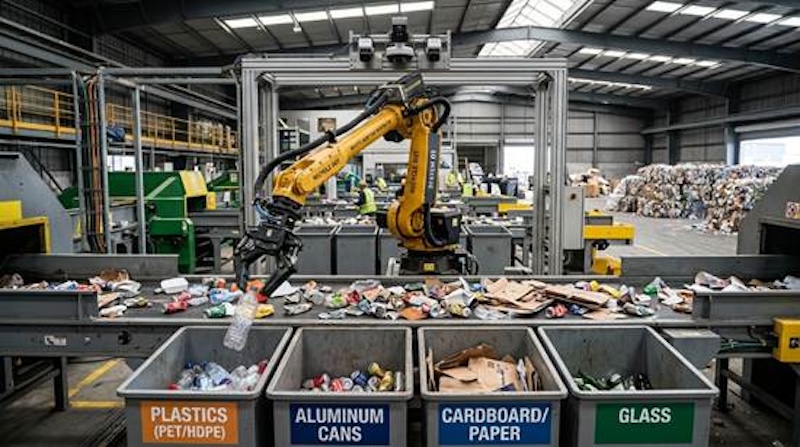
Kingston University will lead NORAH, a £3.6M initiative funded by Innovate UK to validate and deploy robotic sorting systems in real waste facilities. The hub is one of eight sector-specific robotics adoption centers launched under a £40M national scheme. Current automation rates in UK waste processing sit below 5% — operators cite unpredictable performance on contaminated streams and inability to model ROI as primary barriers.
NORAH will provide testbeds using live contaminated waste, including textiles, mixed recyclables, and deformable materials. Systems will be benchmarked with operator-specific samples rather than vendor-provided metrics, generating measured data on classification accuracy, throughput, and contamination handling. This approach targets the gap between lab performance and field deployment in one of the most technically challenging industrial environments for robotics.
The consortium includes the University of Kent, West London Waste Authority, and unnamed robotic developers and waste operators. Services span integration support for legacy infrastructure, workforce training for contaminated environments, and innovation programs focused on mixed fiber sorting and automated disassembly. The hub aims to support 150+ organizations and deliver operational deployments by 2030.
The waste sector represents a high-complexity test case for industrial AI. Materials are variable, often wet or sticky, and constantly shifting — conditions that stress computer vision and manipulation systems designed for structured environments. Success here could inform deployment in similar unstructured settings like construction demolition or agricultural byproduct processing.