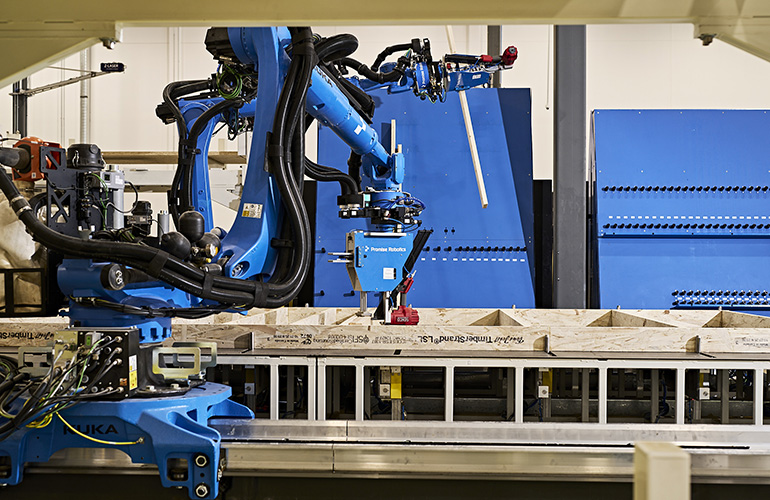
Promise Robotics announced a multi-year FaaS agreement with D.R. Horton to manufacture structural components for over 1,250 homes across U.S. markets. The Toronto-based company uses KUKA robot arms, computer vision, and domain-specific AI models to translate home designs into robotic fabrication instructions, producing walls, floors, and stair assemblies that can be installed onsite in a fraction of traditional build times.
The construction industry has resisted automation due to extreme variability — every floor, wall, and layout differs even within the same home. Promise Robotics addresses this with a software layer that adapts to material constraints, tool limits, and local building codes. The system generates 300 images and 5,000 tactile data points per home, continuously refining its models. Initial facilities in Edmonton, Calgary, and Phoenix can produce a two-story, two-family home with basement and garage in one day, versus the typical two-to-three-week timeline.
D.R. Horton's adoption signals a potential inflection point for construction automation. The U.S. homebuilding market is highly fragmented with seasonal labor and no tradition of capital investment in manufacturing infrastructure. FaaS allows builders to access robotic production capacity without operating their own facilities — a model that could scale across mid-tier regional players struggling with output demands.
The agreement is performance-gated. Promise Robotics must prove cycle time and quality consistency before D.R. Horton commits to broader capacity scaling. The company is starting with townhomes and mid-rise residential, where structural repeatability is higher and the business case is clearest.