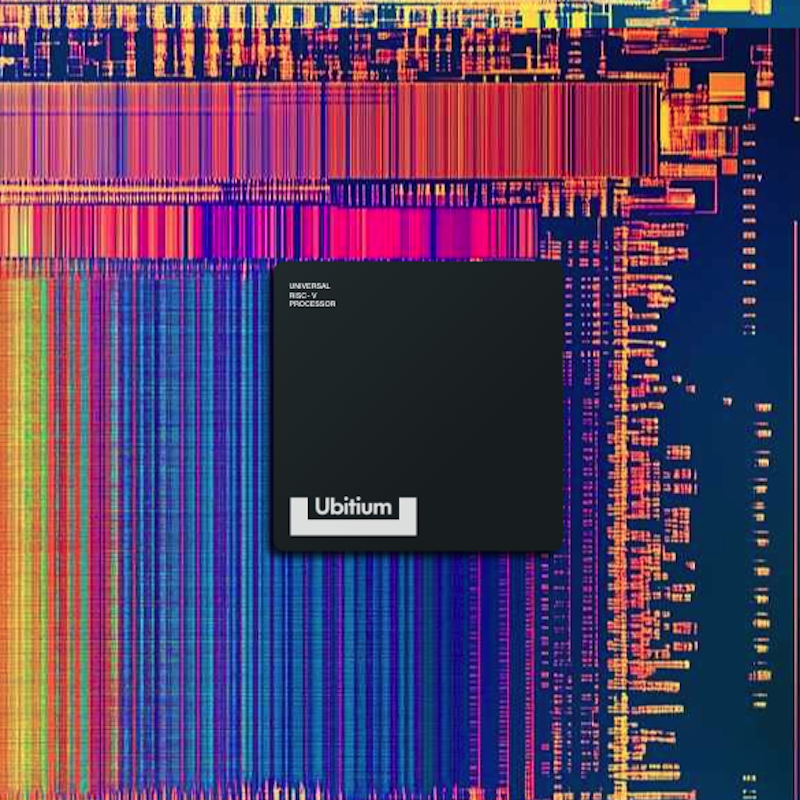
Ubitium closed a $14M seed round led by Ibex Investors, with participation from OpenOcean, KBC Focus Fund, Runa Capital, Inflection, and Quantum Systems co-CEO Florian Seibel. Total seed funding now stands at $18M. The company taped out its first chip, the UB108, a year after founding — demonstrating that signal processing, AI inference, and real-time control can run on one reconfigurable array rather than separate silicon.
The technical thesis addresses a real constraint in autonomous systems: physical AI machines must continuously sense, decide, and act — often simultaneously, on battery power, in real time. Today that work is divided across a DSP for sensing, an NPU for AI, and a CPU for control. Connecting them creates data transfer bottlenecks and engineering overhead. Ubitium's architecture uses a single array of programmable elements that allocate resources at runtime based on the machine's shifting workload.
The startup holds 17 granted patents and its team brings over 250 career patents and silicon experience from Intel, Nvidia, Apple, and Texas Instruments. CTO Martin Vorbach has pioneered reconfigurable computing for three decades. The architecture is built on RISC-V and uses unified memory, simplifying development and reducing chip count.
Initial customers are building radar and audio sensing systems. Autonomous drones are the target application for the full perceive-think-act loop. Ubitium plans to tape out its commercial processor, the UB410 with 4,096 processing elements, and deliver evaluation units in 2027. McKinsey forecasts general-purpose robotics alone could reach $370B by 2040.
The funding validates a bet that physical AI's shifting workloads require hardware that reconfigures with them — a departure from the fixed-function accelerators dominating AI compute today. The question is whether a unified architecture can match or exceed the performance of optimized specialty chips across all three workloads at once.