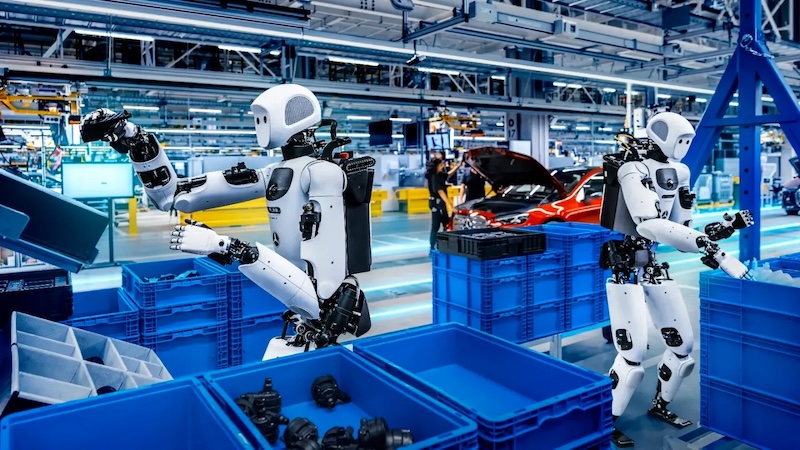
Agility Robotics launched Digit 5, its first humanoid robot designed for large-scale commercial deployment in warehouses and manufacturing facilities. The robot lifts 23-kilogram bins, operates for 90 minutes on a 9-minute charge, and is engineered to work 20-hour shifts alongside human coworkers. Agility's Salem, Oregon RoboFab facility can produce over 10,000 units per year.
Digit 5 marks a departure from Agility's earlier research platforms. ATRIAS and Cassie demonstrated dynamic bipedal locomotion using spring-mass models and reinforcement learning, achieving fluid, naturalistic movement. Digit 1–4 built on those foundations, adding manipulation and commercial pilots with Ford, Amazon, and GXO. But Digit 5 prioritizes reliability and regulatory compliance over aesthetics — it's heavier, bulkier, and designed around the realities of CE and UL certification rather than biomimetic elegance.
The company identified bin handling as its first economically viable application after years of customer engagement. The task requires two arms for large objects, legs for narrow spaces, and adaptability across varied warehouse layouts — a niche underserved by single-purpose automation. Early deployments with Amazon and GXO validated the use case but revealed harsh operational requirements: safety, uptime, and service logistics now drive design decisions more than research goals.
Co-founder Jonathan Hurst acknowledges the tension between his original vision and commercial necessity. Digit 4 EVT added mass and lost graceful movement to meet safety and battery requirements. Digit 5 continues that trajectory, designed from scratch around the first 10 mapped customer use cases. For a company founded on biomechanical theory, the shift represents a calculated bet that functionality unlocks scale — and scale eventually funds elegance.