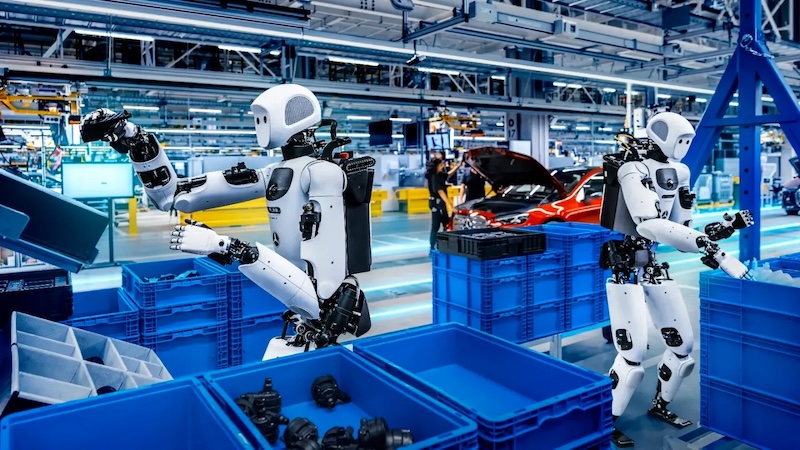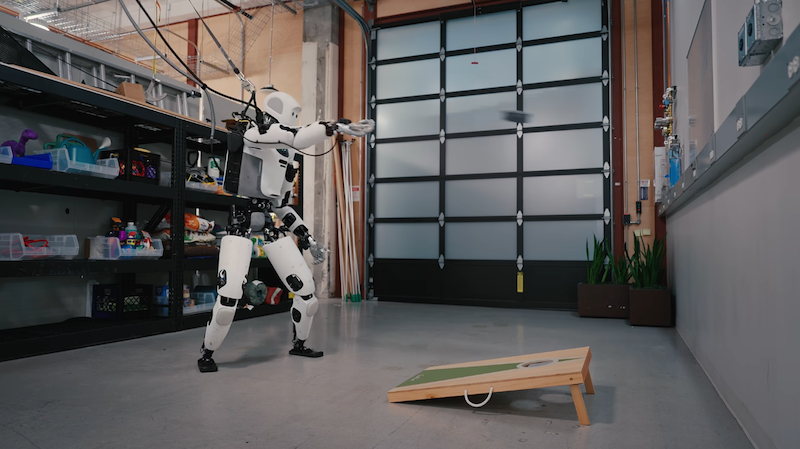
Google DeepMind's Gemini 4 Argon learned to play cornhole by watching raw video, then autonomously transferred the skill to Apptronik's Apollo humanoid. The model analyzed the environment, mapped spatial coordinates, calculated joint movements, and generated simulation code without manual intervention. Apollo subsequently landed seven consecutive real-world shots.
The approach, labeled "Video-to-Sim-to-Real", addresses a core robotics bottleneck: the manual engineering required to model and simulate physical tasks. What typically takes weeks of human work now runs in hours. Argon watches video, reasons about physics and geometry, writes its own sim code, and outputs a behavior policy ready for deployment.
This represents a shift in how humanoid systems could acquire new capabilities. Rather than hand-coding each task or collecting thousands of teleoperated demonstrations, operators could point the model at existing video — YouTube, internal training footage, competitor demos — and accelerate skill acquisition at scale.
Google also tested Argon on its Embodied Reasoning benchmark (ERQA), which measures spatial and physical reasoning in 3D environments. The model scored 87 percent. The company is positioning Argon for broader engineering and scientific tasks, including quantum computing and life sciences, but the robotics demo signals where commercial humanoid development may be heading: models that learn by observation, not just instruction.