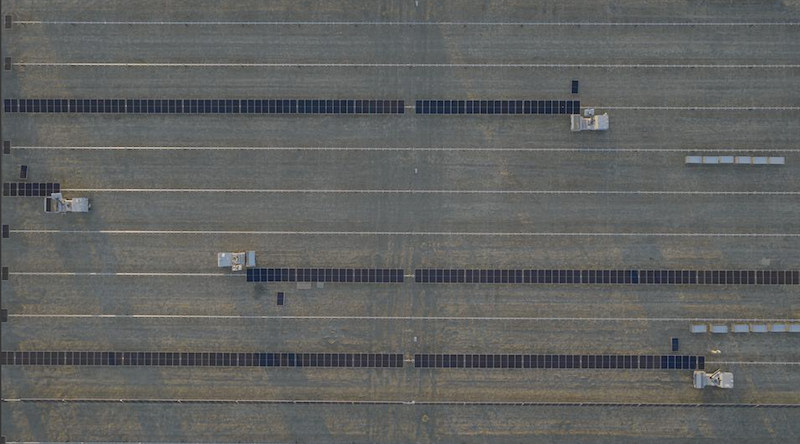
Maximo Robotics announced it has completed over 300,000 construction tasks using its Max 4.0 autonomous platform across utility-scale solar projects in California, Illinois, Kansas, Louisiana, New York, Texas, and Washington. The company operates under a performance-based RaaS model where customers pay per completed task — primarily millimeter-precision placement of heavy solar modules. Crew members working alongside the robots delivered 2.5x their manual installation rates per person per shift hour.
The platform combines three proprietary components: Cortex (vision and planning AI models), Form (ruggedized robotics hardware for multi-shift operation), and IQ (a service performance management system with continuous learning loops). Every completed task feeds data back into the system, improving future deployment performance — a closed-loop advantage that scales with fleet size.
Six large EPC contractors are currently deploying Maximo systems, with a 10x pipeline expansion planned for 2027. Primoris Services Corporation's Renewables business served as an early integration partner, embedding the technology into field operations and refining it in real time with craft professionals. The push is driven by skyrocketing electricity demand and a construction labor market that the Associated Builders and Contractors projects will face a 450,000-worker shortfall in the US by 2027.
Maximo's immediate roadmap includes expanding from module placement into module attachment and field logistics within solar, then into adjacent construction domains with similar pick-and-place, feeding, and site logistics needs. The company positions itself not as a robotics vendor but as a scalable Physical AI platform for critical infrastructure construction.