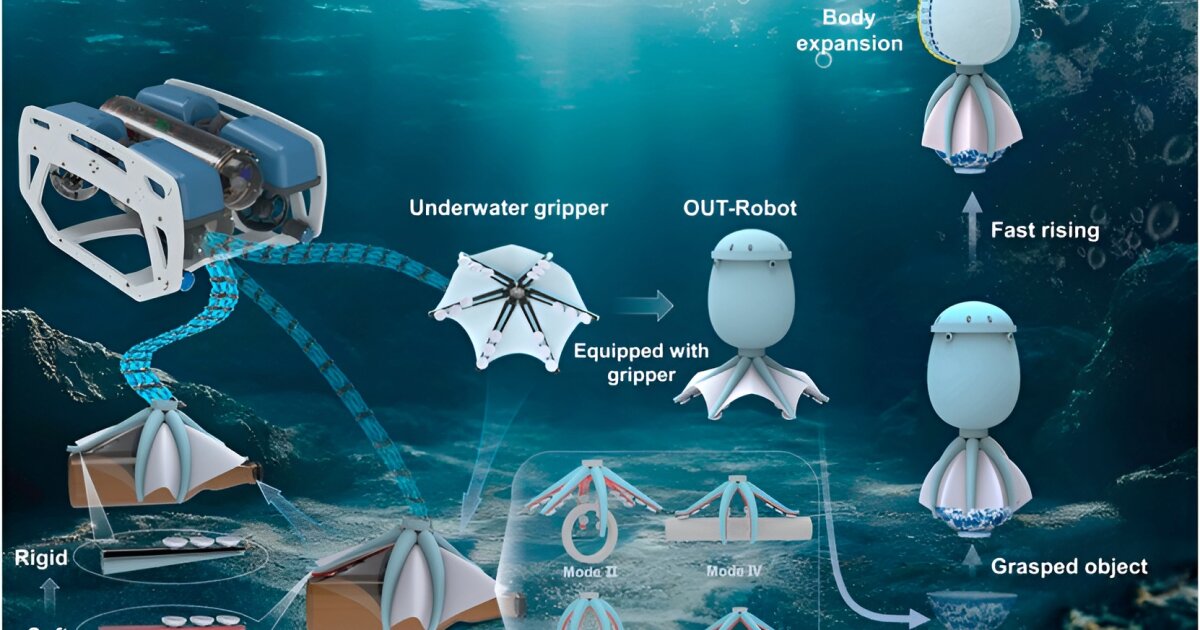
The OUT-Robot (Octopus-Inspired Upward Transport Robot) solves a core gripper problem: rigid mechanisms crush delicate objects, while soft grippers lack lift capacity. By using shape memory polymer (SMP) arms made from 3D printer-grade PLA, the system softens under voltage and re-hardens when heating stops. A three-layer thermal interface uses water as an active heat sink, cutting state transition time from tens of seconds (typical for air-cooled SMPs) to under 2 seconds.
Each of the robot's six arms operates independently. When soft, they conform to irregular surfaces via suction or wrapping. Once the arm locks rigid, it holds the object with zero additional energy. The team reports that SMP tentacles are 25x more rigid than non-SMP equivalents, enabling lift capacity exceeding 400 grams per robot.
The system demonstrated underwater versatility in a 2-meter pool: it sorted debris including rocks and bottles, retrieved sub-gram fishing nets, collected fragile biological samples, and lifted a glass bottle — all in continuous operation. After gripping, the robot inflates its soft head like a balloon for buoyancy-driven ascent, consuming near-zero energy during the lift phase compared to propeller-driven systems.
Applications target ocean cleanup, biological sampling, and resource recovery. Lead researcher Professor Xie Guangming suggests swarm deployments for large-scale marine operations, positioning the system as a quiet, energy-efficient alternative to conventional ROVs.