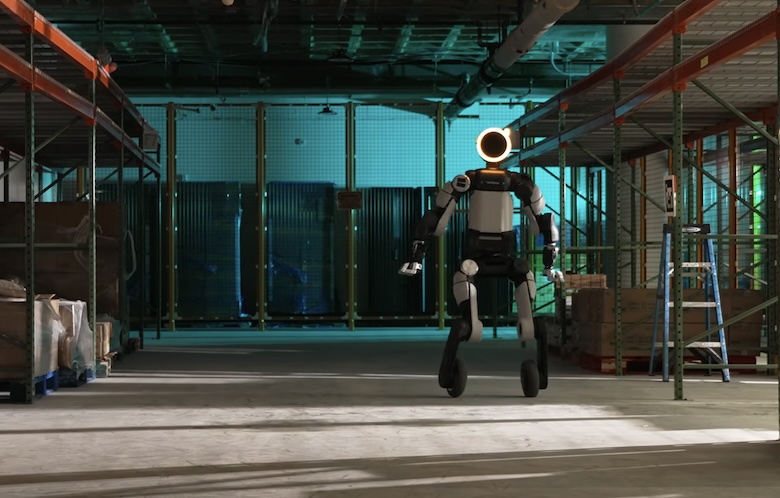
UC Berkeley and NVIDIA released two open-source tools — Graph-as-Policy (GaP) and VABAR — that use teams of AI agents to code, simulate, and refine industrial robot programs. The system splits tasks into modular skills like perception and motion planning, assigns each to an agent, and iterates in simulation until the code works. The output is human-readable Python that calls existing vendor modules like KUKA controllers.
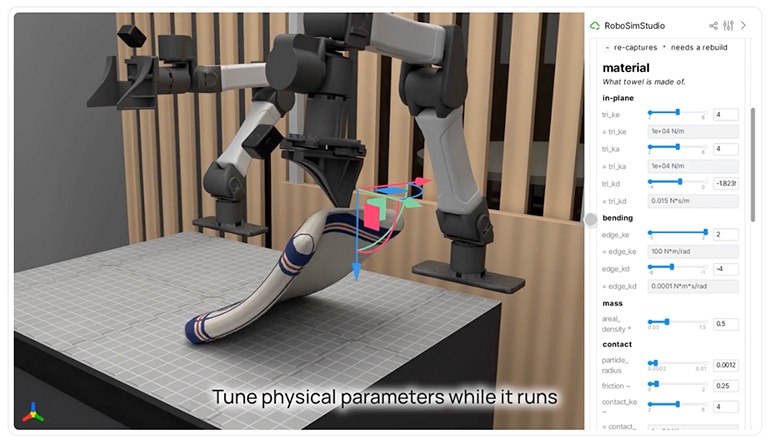
The technical advance is RoboSimStudio, a UI built on Newton physics engine that makes hundreds of simulation parameters accessible to AI agents. Previously, Newton's complexity kept it underutilized. With RoboSimStudio, agents can tune physics parameters autonomously and test code against realistic contact-rich scenarios — tool sorting, cable routing, gear meshing — defined in the VABAR benchmark.
Traditional industrial robot programming requires physical workcells to be fully installed before coding begins, creating bottlenecks at project deadlines. Agentic robotics inverts this: simulation becomes the testbed, and agents iterate code before hardware arrives. Berkeley demonstrated a case where GPT-6 Astra generated a full Newton simulation from a video in under an hour with no human tuning.
Bosch Research is evaluating the toolset for industrial automation, citing the interpretability of the generated code as critical for production deployment. Ambi Robotics reported using agentic robotics to convert production data into robot behavior updates, increasing throughput across its U.S. fleet while keeping engineers in control of validation.
The framework outputs ROS 2-compatible graphs and does not replace low-level robot controllers — it sits at the application layer. The question for operators: whether simulation fidelity is high enough to replace or significantly reduce real-world tuning cycles, particularly in unstructured or high-variability environments.