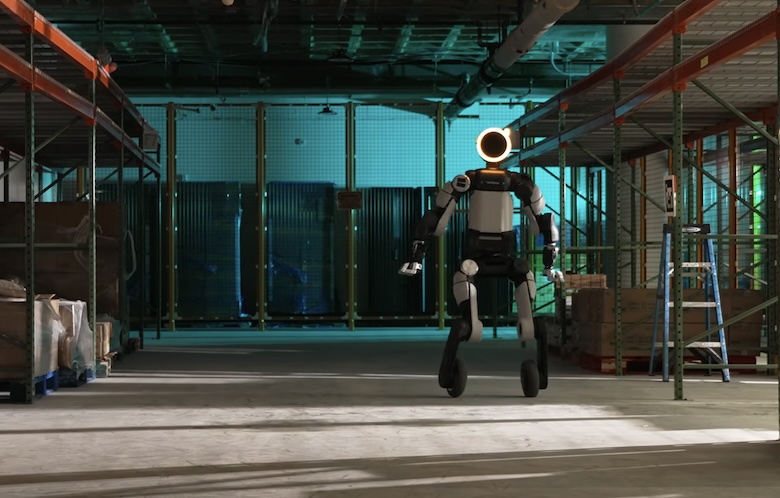
Boston Dynamics published results from a controls engineering experiment where Atlas used off-the-shelf scooter wheels mounted to its ankle actuators. Controls engineer Andy Wu trained the system entirely in simulation, then deployed the policy on hardware with minimal real-world tuning. The robot successfully performed pirouettes, aggressive maneuvers, and smooth transitions between rolling on flat ground and legged motion over obstacles.
The technical goal was to test whole-body reinforcement learning (RL) as a complement to classical model-based control. Pure model-based systems struggle with unmodeled disturbances and irregular contact states in real environments. By integrating a whole-body RL policy, Atlas processes real-time proprioceptive feedback and velocity commands to adjust pose and force dynamically, mitigating disturbances that deterministic models can't predict.
The hardware retrofit was trivial — a single custom adapter mounted a scooter rim onto Atlas' existing ankle actuator. Wu described it as "about as involved as swapping a wheel on a bicycle." The software change was equally minimal: each wheel was modeled as an ankle that can spin continuously, requiring only a swap in the baseline robot model.
The next phase will test policy response to actuator failure — critical for safety assurance and understanding degraded-state behavior. Wu emphasized that the experiment demonstrates control synergy: merging classical motor control for baseline stability with whole-body RL for reactive adaptation produces superior real-world agility compared to either approach alone.
This comes as Boston Dynamics prepares to deploy Atlas at Hyundai facilities and continues development of its four-fingered gripper. The wheeled experiment adds a data point to the industry debate over humanoid form factors — how human-like does a robot need to be to succeed in human-centric environments? Agility Robotics recently signaled interest in exploring wheeled configurations beyond its flagship Digit platform, suggesting the question is increasingly live for commercial operators.