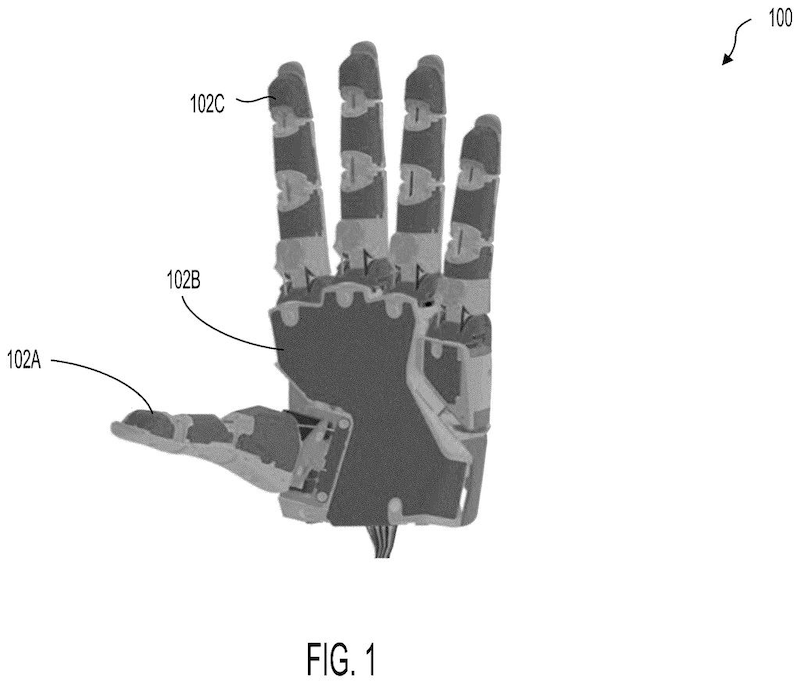
Tesla's patent application US 2026/0310299 A1, published October 8, describes a tactile sensor system built from two flexible substrate layers carrying conductive regions, separated by a compressible layer. Where regions overlap, they form individual sensing points that detect pressure changes. The design supports both capacitive and piezoresistive detection modes.
The filing lists thermoplastic polyurethane, PET, and polyimide as candidate substrate materials. Sensors are printed flat, then heat-formed into three-dimensional shapes that conform to curved geometries — a key requirement for robot fingertips and palms.
What distinguishes this from academic tactile sensing work is the manufacturing focus. Tesla describes screen printing, laser cutting, conductive paste deposition, and thermoforming — all established industrial processes. If the design works as specified, it offers a path to volume production without exotic materials or cleanroom assembly.
The patent does not specify sensitivity, resolution, or durability figures, so practical performance remains unquantified. It also does not confirm deployment in Tesla's Optimus humanoid, though the application explicitly names robot fingertips, palms, and end-effectors as use cases.
Tactile feedback is a bottleneck in humanoid dexterity. Current systems can grasp, but lack the fine force control needed to handle objects with varying compliance, weight distribution, or fragility. Scalable tactile sensing addresses this gap — if it can survive real-world wear and provide useful signal-to-noise ratios.