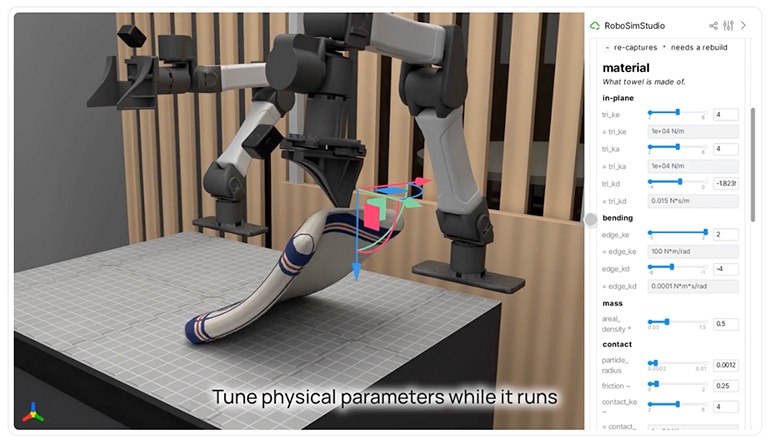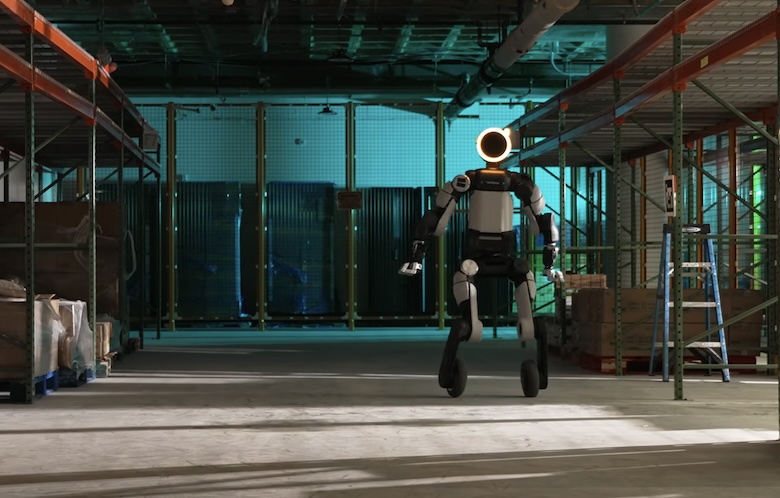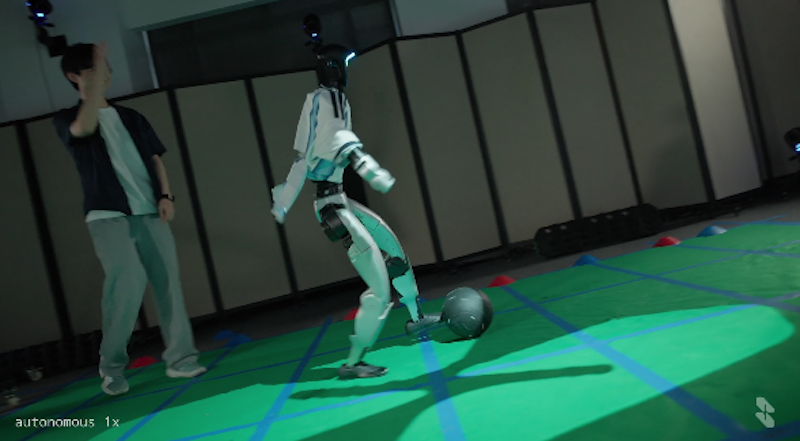
Skild AI trained a humanoid robot to play soccer by having its S1 foundation model compete against progressively stronger versions of itself in simulation. The model received a single objective — score a goal — and developed dribbling, tackling, and recovery behaviors without individual reward engineering. After 140 simulated years using Nvidia Isaac Sim, the policy transferred successfully to a physical humanoid.
The technique extends self-play methods proven in software AI (AlphaGo, StarCraft II, Dota 2) into the physical domain. Unlike those systems, physical self-play must learn both strategy and the motor control required to execute movements in real-world environments with gravity, friction, and mechanical constraints.
Skild argues that models trained primarily on human demonstrations are "capped at human capability." Self-play allows robots to surpass those limits by generating vast amounts of autonomous experience. The company is now extending the approach to everyday robotics tasks and experimenting with multi-agent coordination including passing and collaborative manipulation.
The work addresses a major scaling problem in Physical AI: the volume of human-labeled data required to teach complex behaviors. If self-play transfers reliably to industrial and commercial tasks, it could dramatically reduce the time and cost of deploying capable robots in unstructured environments.
Skild is scaling experiments to larger agent groups and longer simulation runs. The question is whether behaviors learned in virtual construction sites, factories, or homes will transfer as cleanly as they did in soccer — and how robust those policies are to real-world edge cases not covered in simulation.