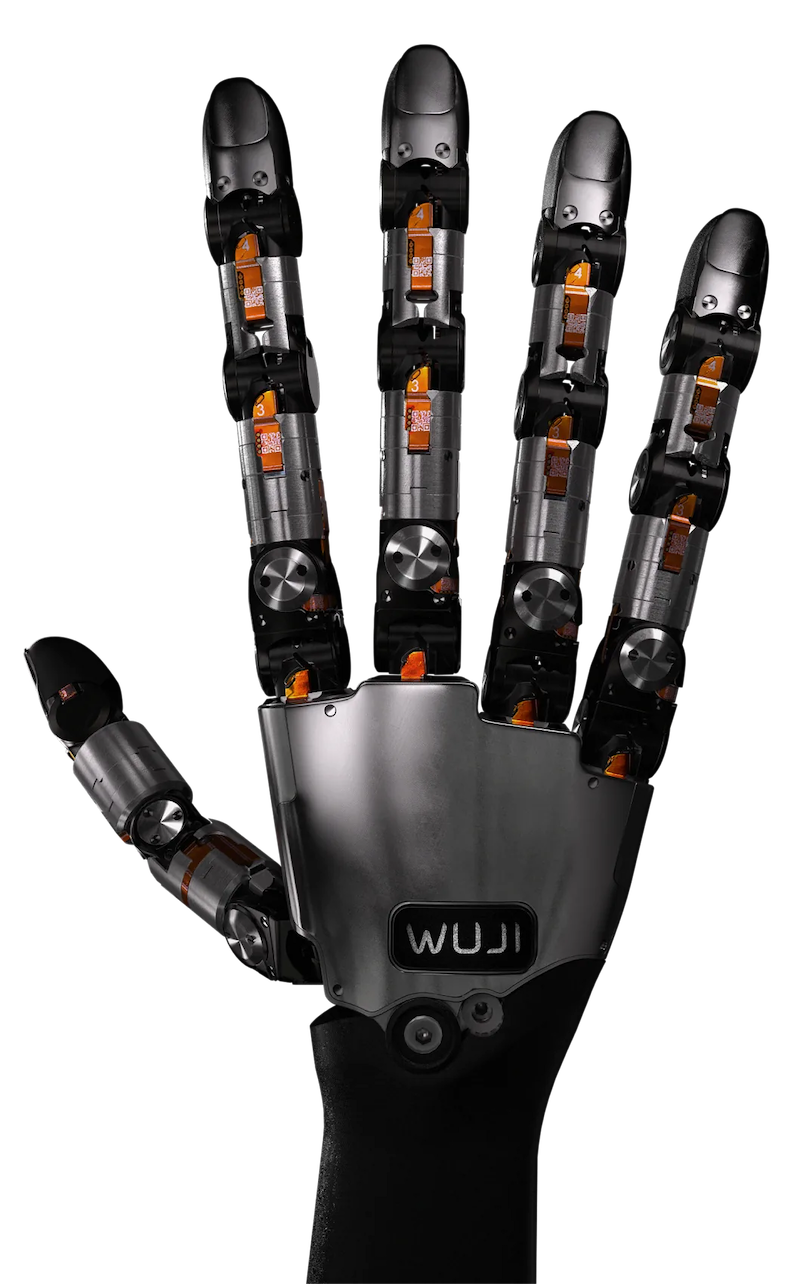
ETH Zurich researchers trained a commercial WUJI robotic hand to walk on its fingers, creating what they describe as a "compact mobile manipulator." The system performs both locomotion and manipulation using the same mechanisms, without requiring a robot arm or wheeled base. Training used reinforcement learning in simulation, with the team developing custom reward functions that outperformed those originally designed for quadruped robots.
The physical system operates untethered with onboard power and computation. In demonstrations, it crawled autonomously, steered, and recovered after falls. It also performed manipulation tasks while self-supporting, including pressing keyboard keys in sequence and pushing objects to specified targets using overhead vision feedback.
The research highlights a growing trend: dexterous hands transitioning from passive end effectors to standalone research platforms. WUJI's hardware is increasingly used as a data collection tool—operators wear the WUJI Glove to teleoperate the hand in real time, capturing human demonstrations for training embodied AI models. The company supports Nvidia Isaac Teleop and demonstrated its latest systems at IROS 2026 in Pittsburgh.
The work raises questions about form factor optimization in robotics. While crawling fingers are unlikely to replace wheeled or legged platforms in production environments, the demonstration shows how capable manipulation hardware can be repurposed when paired with modern learning methods. It also underscores the value of commercial off-the-shelf dexterous hands as flexible platforms for exploring unconventional robot architectures.