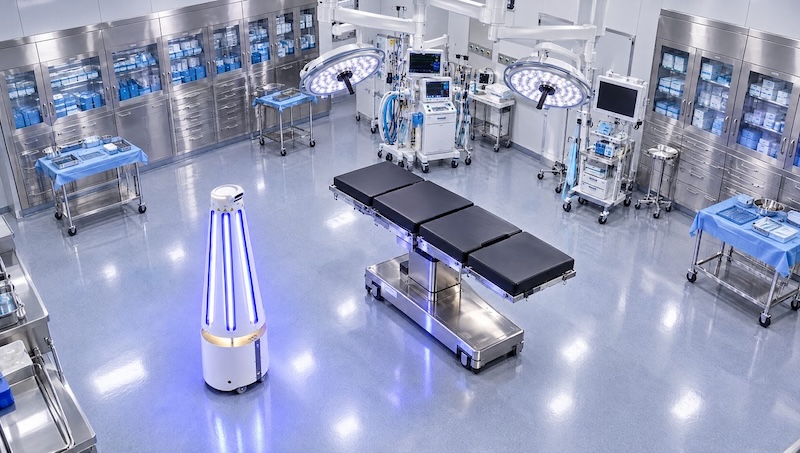
Researchers at Leiden University's Institute of Biology tested Ryberg Healthcare's Omnia robot in a furnished laboratory emulating a hospital environment. The autonomous UV-C system achieved bacterial reductions exceeding 7-log for Escherichia coli and over 5-log for Pseudomonas putida, a model for the hospital pathogen P. aeruginosa. On the robot's "Deep" setting, Bacillus subtilis reduction exceeded 7-log, meeting international acceptance criteria requiring at least 5-log reduction.
The study directly compared autonomous versus static UV-C disinfection. In static testing per British standard BS 8628:2022, the robot achieved 4.0-log E. coli reduction—below the 5-log threshold. With autonomous operation enabled, the same robot exceeded 7-log reduction. The difference was most pronounced in partially shadowed areas where static devices cannot maintain line-of-sight exposure.
This matters because hospital-acquired infections remain a persistent problem despite manual cleaning protocols. UV-C disinfection offers a supplementary layer, but deployment has been limited by the need for fixed positioning and coverage gaps. Autonomous systems that navigate and adapt to room geometry could expand viable use cases.
The study was conducted in a controlled laboratory, not an active hospital ward, and did not simulate patient beds or bathrooms. Researchers noted these limitations and indicated further testing is planned with additional pathogens and shadowed configurations. Real-world performance in occupied facilities with furniture variability remains to be validated.