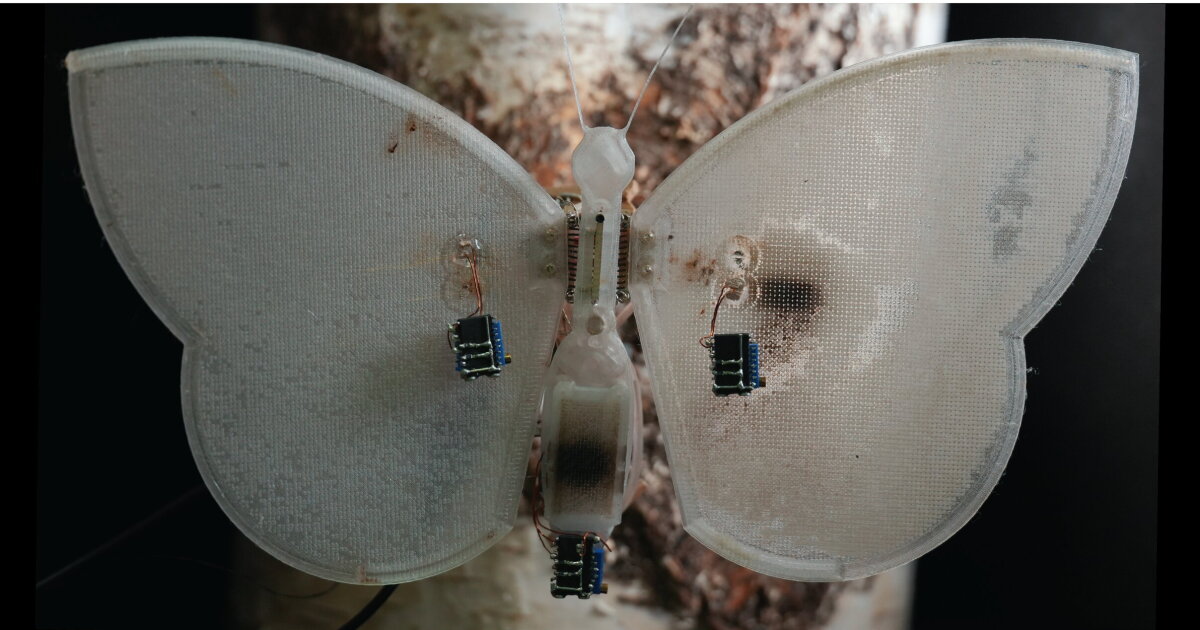
The robot uses a closed-loop circulatory system pumping 3ml of pyrrole solution through microchannels embedded in transparent 3D-printed wings. UV exposure triggers polymerization of the fluid into polypyrrole — a conductive polymer — forming a functional sensor patch within minutes. Pre-threaded gold wires detect resistance changes when the grown sensor responds to light, triggering wing actuation via nitinol wire.
The proof-of-concept addresses a fundamental limitation in autonomous systems deployed in unpredictable environments: robots leave the factory with fixed sensor suites. By enabling in-situ sensor formation based on actual environmental conditions, the approach could support long-duration missions in collapsed structures, planetary exploration, or infrastructure inspection where pre-positioning sensors is impossible.
Key technical constraints remain. The sensor formation is irreversible, wing actuation requires external power, and sensor placement currently requires manual stenciling rather than autonomous environmental patterning. The grown sensors showed stable performance after four months and increasing sensitivity with repeated UV exposure, but reset time is approximately five minutes per cycle.
The team is exploring energy-harvesting chemistries that could power onboard electronics directly from the circulating fluid, and reversible material systems that would enable sensor reuse. The approach builds on prior work in self-healing soft robotics and 3D-printing filament-based construction, but represents the first demonstration of circulatory-based sensor synthesis in response to external stimuli.